Story Of The Grady Sensor
The Grady Seed Moisture Sensor, produced by Digital Seed Technology in 2025, is named after Dr. Thomas Grady Chastain. Dr. Chastain received his Ph.D. in Crop Science from Oregon State University (OSU) in 1987. He returned to OSU in 1989 as an Assistant Professor in Seed Crop Physiology and Ecology and retired as Head of the Crop and Soil Science Department at OSU in 2024. He served on the Board of the Crop Science Society of America and is Past-President of the International Herbage Seed Group. Dr. Chastain spent his research and teaching career focused on seed. His interests included seed germination and stand establishment, seed development, and seed production. Dr. Chastain was not only recognized as an outstanding classroom teacher, but also as someone who made important scientific contributions which have improved our understanding of seed crop physiology, particularly in herbage seed crops. Investigating whether near infrared sensor technology could be used to measure seed moisture content in grass seed crops was one of Dr. Chastain's final research questions while at OSU. Drs. Anderson and Zhou are grateful to have had the opportunity to investigate this question, validate findings, and develop The Grady Sensor - a practical agricultural sensor product - now available to the global seed industry.
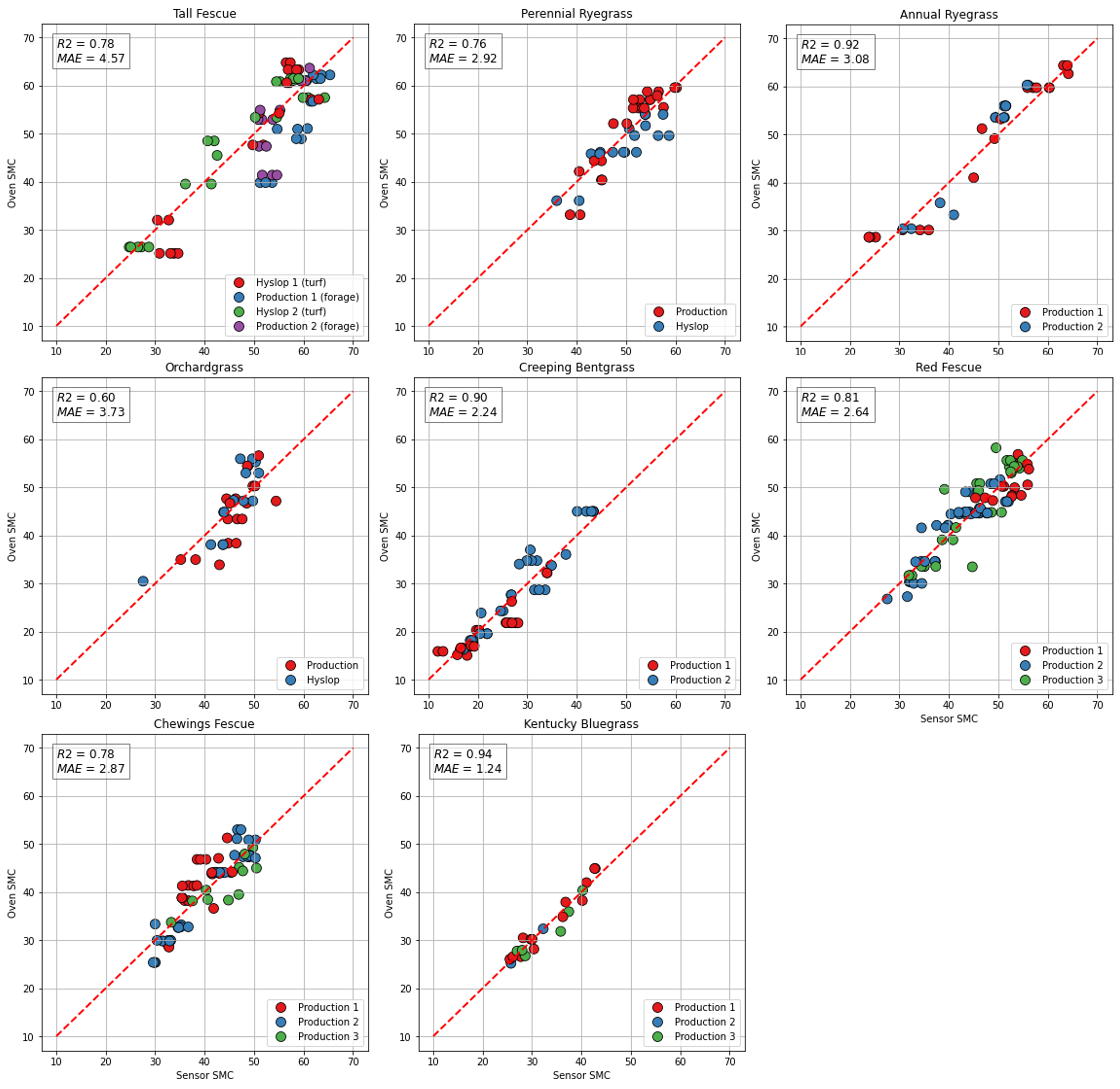
Testing Report
The Grady Sensor has been calibrated and validated under rigorous processes with samples from commercial seed production fields and experimental plots in Oregon and New Zealand. Data collection began at the onset of externally visible seed fill (presence of an endosperm) and continued daily though harvest. Representative samples were taken from each field by stripping seed from a minimum of 30 seed heads and thoroughly cleaned. Sensor readings were then taken and compared with laboratory oven seed moisture content (SMC). The Grady Sensor has been validated for 8 economically important cool-season grass crop species, namely tall fescue [Schedonorus arundinaceus (Shreb.) Dumort.], annual ryegrass [Lolium perenne L. ssp. multiflorum (Lam.) Husnot], perennial ryegrass (Lolium perenne L.), orchardgrass (Dactylis glomerata L.), creeping red fescue (Festuca rubra L. subsp. rubra), creeping bentgrass (Agrostis stolonifera L.), Chewings fescue [Festuca rubra L. subsp. fallax (Thuill.) Nyman], and Kentucky bluegrass (Poa pratensis L.).